Bypass 16 Month
GSC Data Limits
Sign up, import a website and your warehousing will begin right away. Simple, secure & fast. Access every bit of historic data with no limits. Ideal for storing important performance & keyword data.
SEO Stack makes it quicker & easier to find out how your traffic has changed over time. Apply a timeframe and off you go.
Trusted by teams at:










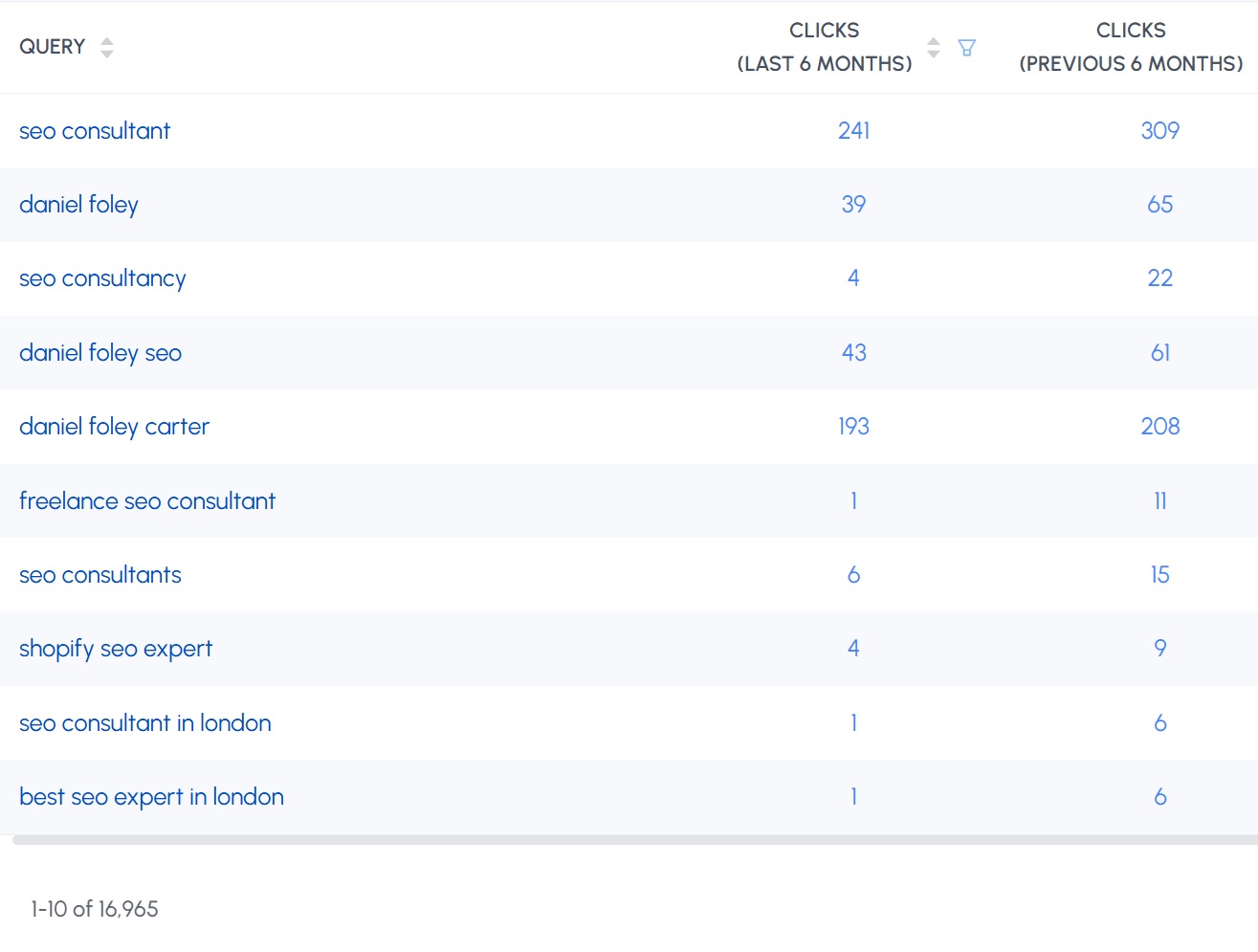
In 1 click you can quickly and easily compare timeframes to see how traffic has changed across the comparison timeframe. Unlike GSC, we don't limit you to 16 months nor do we limit the row counts!
Get started and setup in as little as 5 minutes.
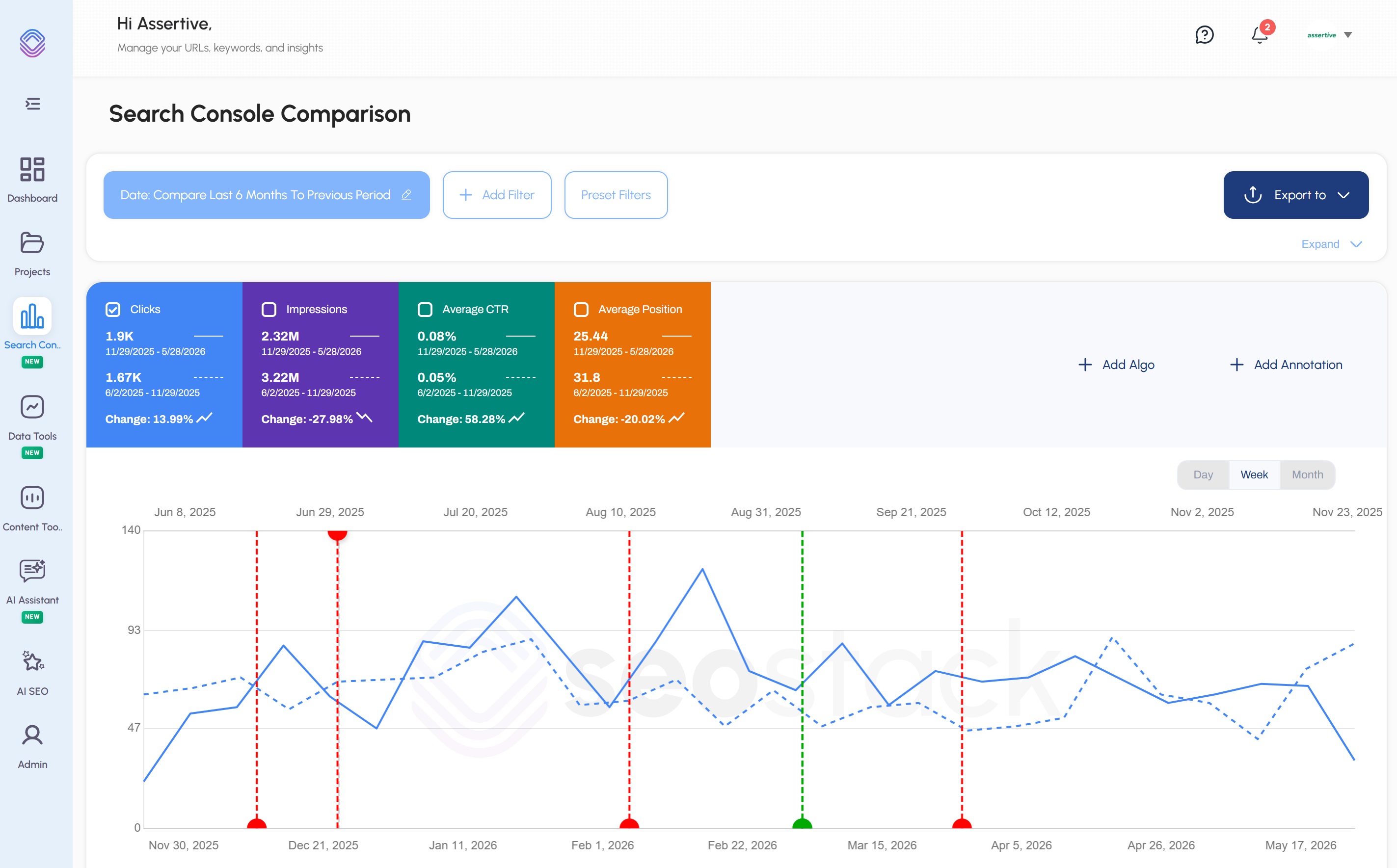
Unlike Google Search Console which limits your row exports on date comparisons, SEO Stack does not. It makes it significantly easier & quicker to pin point traffic gains across queries, pages, devices etc.
Using smart AI annotations & SEO Stack's AI assistant, it's never been quicker or easier to find trends & changes from content decay and ranking losses through to finding which pages/queries are in growth, which have been dropped or lost from the index.
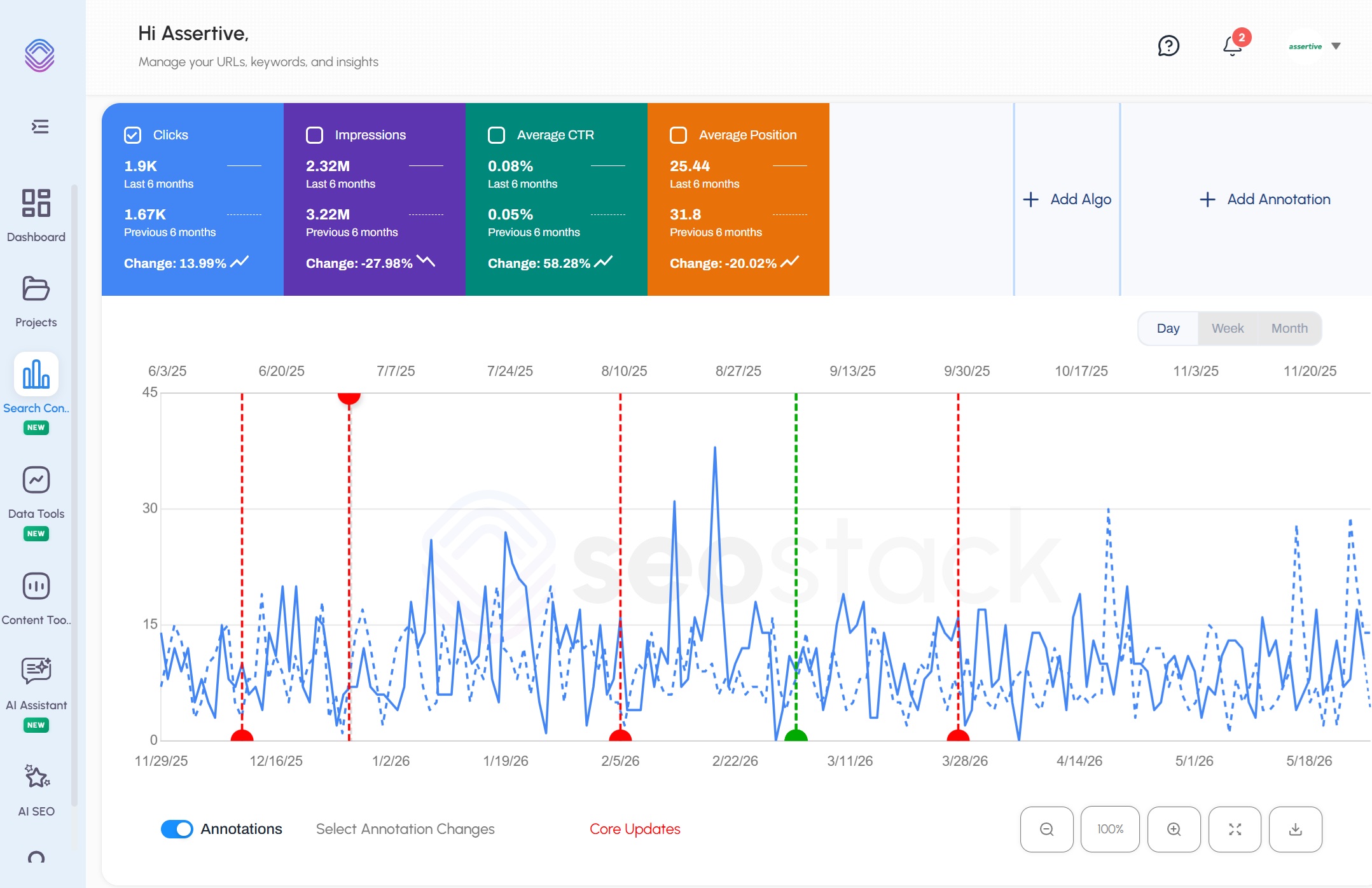
AI-powered smart annotations automatically flag ranking shifts, algorithm updates, and traffic changes - so you always know what caused the movement.
You can now effortlessly ask SEO Stack's AI Assistant to look at comparison data whether you are comparing a timeframe before a Google core update and after, or after making website changes or comparing historic data - SEO Stack's AI Assistant can help.
SEO Stack makes it quick and easy for users to see what annotations were logged & what google updates happened across the comparison timeframe making it easier to understand whether changes you made or whether a Google core update had an impact on rankings & traffic.
Get started in less than a minute!
Packed full of useful features to make it quicker, easier & faster for SEOs to get more from their data & to deliver better SEO campaigns for clients.
Don’t just take our word for it. Hear from the SEO professionals who trust our platform to drive their success.

“So much of our work is analysing data within GSC that the speed at which SEOstack can pull up this data, allow us to apply multiple filters and analyse it pays for itself in efficiency alone.”

“SEO Stack really makes a lot of arduous processes a lot easier, and delivers value where Google Search Console never managed quite hit the mark. It's truly a game-changer for SEO reporting and strategy.”

“SEO Stack has to be THE best tool for getting more out of Search Console, and if you're working with mid to large sites, it's kind of a no brainer. Just a few things you can do are layer filters, add annotations, and view and export ALL the data (not just 1000 rows!) - stuff it feels like Search Console should be able to do, but can't. SEO Stack fills those gaps, and more.”

“Whether you're deep in technical audits or scaling content production, SEO Stack gives you the horsepower and clarity to execute with precision. It's not just another tool - it's your unfair advantage.”

“If you're serious about SEO now - and in the future - SEO Stack should be in your arsenal. Don't just optimise. Dominate.”
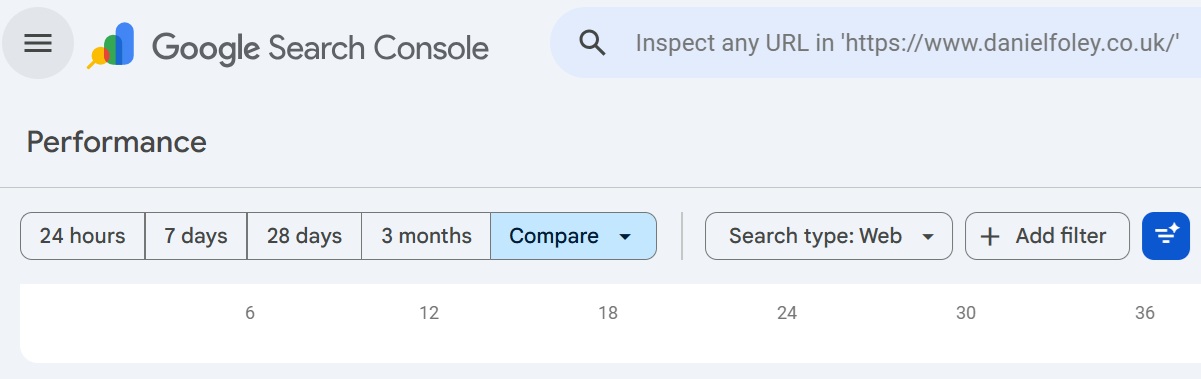
Google Search Console (GSC) gives every site owner a free way to compare two time periods of search performance. It's genuinely useful, and for most people it's the first place they look when clicks show a noticeable change. But the comparison view in GSC is built on a set of hard limits that quietly cap what you're able to see.
On any site bigger than a few hundred URLs, those limits mean you're making decisions on a fraction of your own data which is terrible from an SEO perspective. For queries it's even worse - when performing any meaningful analysis, Google's hard 1,000 row caps make it near impossible to make SEO decisions from the given data.
Here's how the GSC date comparison actually works, exactly where it stops being useful, and how SEO Stack picks up where Google leaves off.
Inside the Performance report, GSC lets you put two date ranges side by side. Open the date picker, switch to the Compare tab, and you can choose:
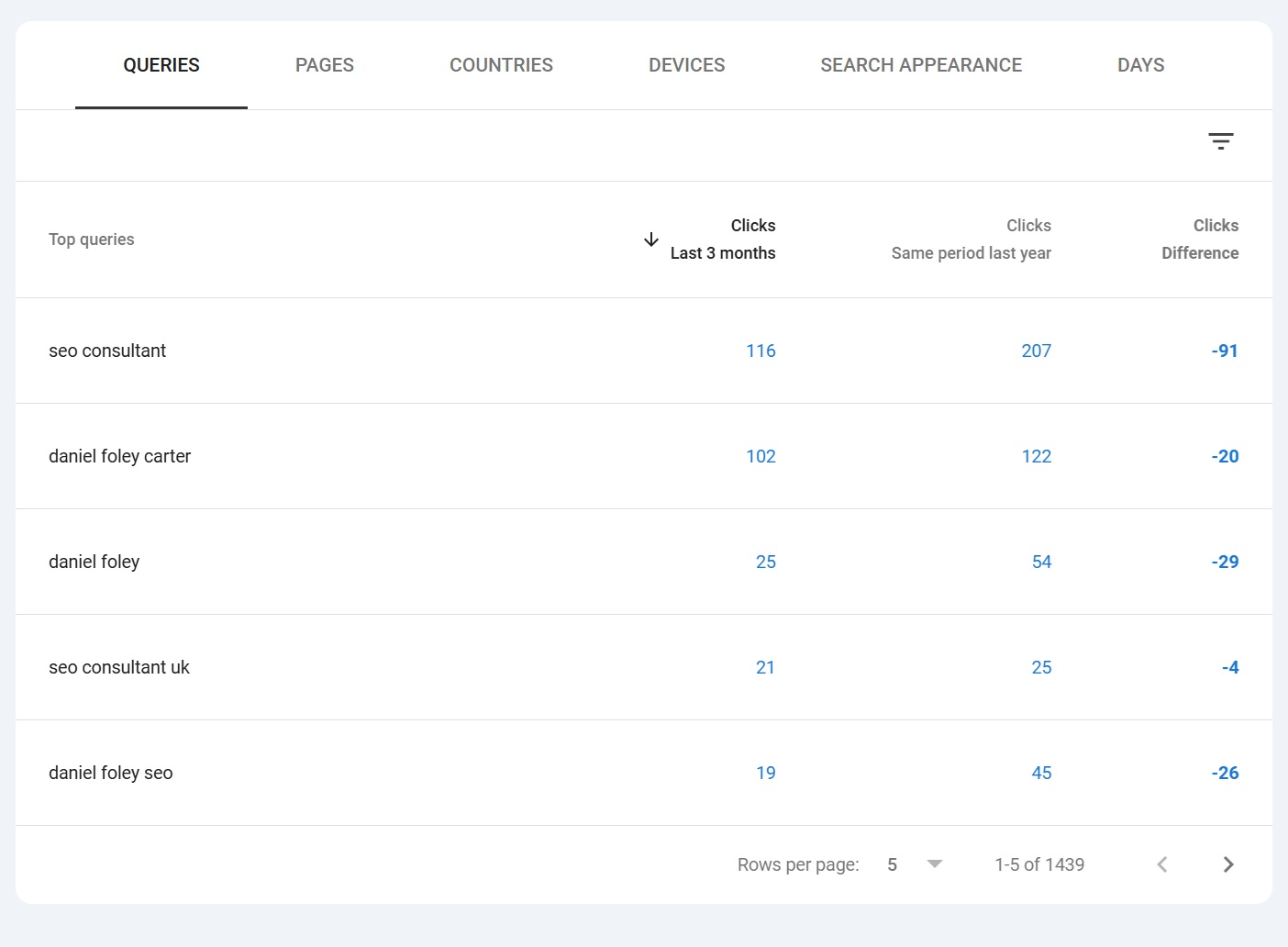
Once a comparison is active, GSC adds a second line to your performance chart and a difference column to the Queries and Pages tables underneath. You get the change in clicks, impressions, CTR and average position for each row, and you can sort by the difference to see your biggest movers.
It's the right instinct: compare before and after, then sort by what changed. The problem is everything Google does not show you once you start relying on it.
Understanding exactly what GSC won't show you - and where those gaps cost you the most.
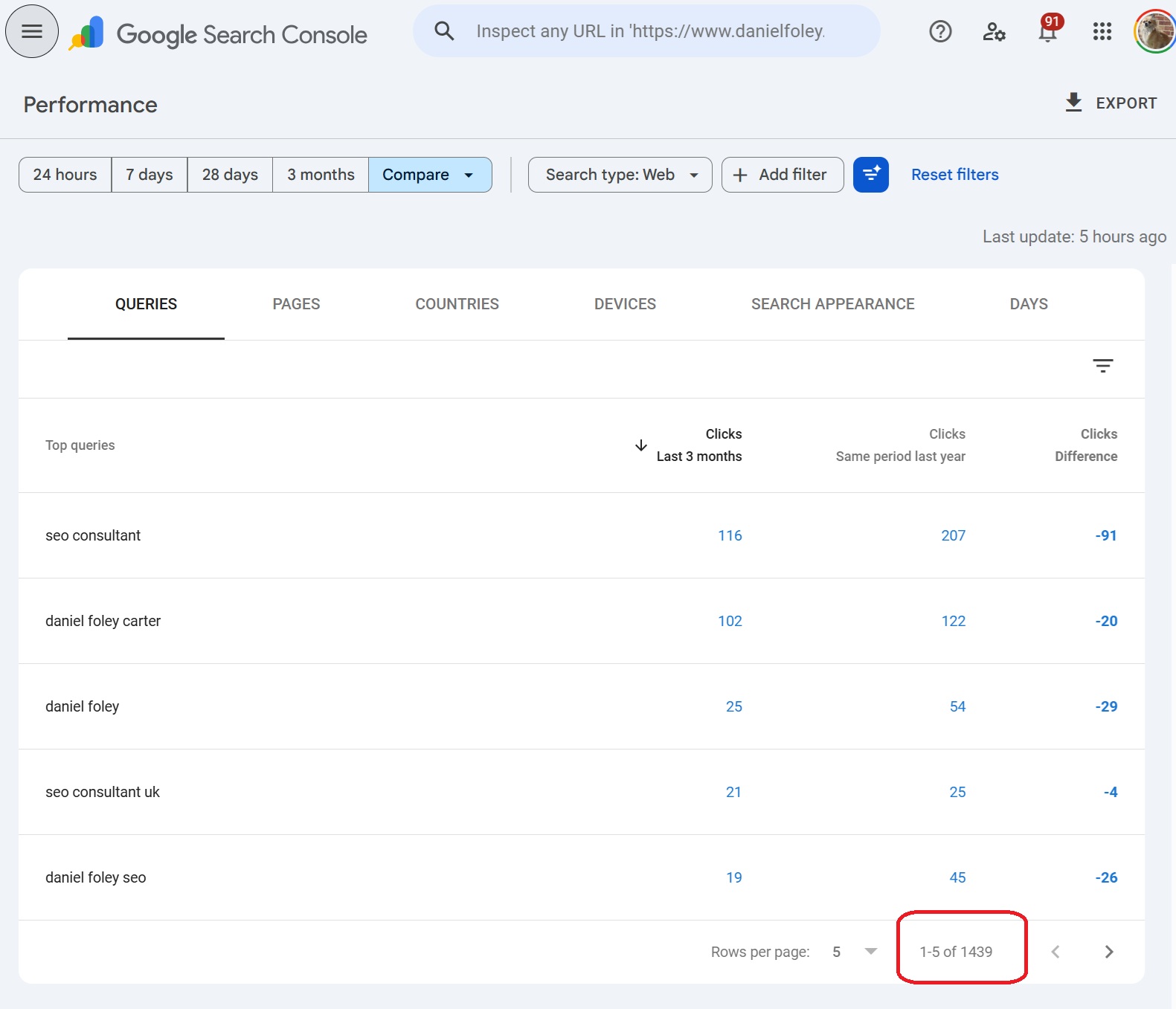
This is the main issue that impacts SEOs, especially those auditing. The GSC interface and any export you pull from it is capped at 1,000 rows, ordered by clicks and impressions. For comparison data sets, queries are usually capped below 1,700 - for most, a huge majority of comparison data is omitted from exports.
If your site ranks for more than 1,000 queries (most do, even small ones), or has more than 1,000 indexed URLs, your comparison is silently truncated. The group of queries that dropped 90% after the last Google core update might sit at row 1,400, so it's omitted and you never know it moved. Any filtering you do in the UI is just client-side JavaScript running over those first 1,000 rows, not a fresh pull of your full dataset.
You can work around it with the Search Console API (up to 25,000 rows per call, 50,000 per day), but that means writing code, handling OAuth, managing quotas and standing up a database - a genuine headache. SEO Stack removes this limit entirely.
GSC keeps performance data on a strict 16-month rolling window, so for every day you gain is a historic day you lose. Every day a new day is added and the day from 16 months + 1 ago is permanently deleted. There is no archive and no recovery unless you have Google BigQuery set up.
That has two key consequences for comparison:
If you didn't export it before Google deleted it, it no longer exists.
GSC's comparison requires the two periods to be exactly the same length. You can't put a 3-month window against a 6-month window, or compare an irregular promotional period against a clean baseline. You have to match the dates exactly - which can be slow and clunky to configure.
This forces artificial constraints on your analysis. Real-world SEO questions rarely fit into equal-length date boxes, and GSC gives you no flexibility to work around it.
GSC won't tell you why something moved. There are no annotations for the changes you made - be it content rewrites, redirects, technical fixes - and no overlay of Google's algorithm updates. So when clicks fall off a cliff on a given week, you're left to figure it out yourself.
Whilst GSC now supports annotations, they're super generic and not URL-specific. You can't see whether a drop aligns with a core update, a crawl spike or a change you made to the page - you're just looking at numbers with no story attached.
The comparison shows clicks, impressions, CTR and position - and that's it. It won't let you know that a URL is now returning a 404 or a redirect, when a page last received a click, or how click share is distributed across your URLs.
When a page disappears from comparison results you don't know if it's a technical issue, a de-indexation, or simply a ranking collapse. The data you need to diagnose the drop isn't in GSC's comparison view at all.
The difference column is raw numbers - there's no trend visualisation across the comparison like there is in SEO Stack, and nothing that interprets the movement for you such as SEO Stack's AI assistant.
Finding which keywords dropped out entirely, which pages disappeared, or which pages are brand new is manual, row-by-row detective work that takes time and costs money. There's no signal separation between noise and genuine ranking movement, and no way to surface the patterns that actually matter without doing it all yourself.
Where GSC cuts you off, SEO Stack does not. See an example of a last 3 month year-over-year comparison at query level.
Unlock the full potential of your Google Search Console data with our comprehensive suite of advanced features.
Store, browse and interact with every byte of your Search Console history - no 16-month wall, no sampling.
Stack contains, excludes, regex, position and CTR filters - even conflicting ones - in a single view.
Build a library of named filter combinations and re-apply them across any project in one click.
Switch granularity instantly - spot daily anomalies or weekly/monthly trends without rebuilding queries.
SEO Stack watches your data 24/7 and flags meaningful shifts - algorithm hits, content wins, decays - automatically.
Every Google update plotted directly on your performance charts - see impact at a glance.
Queries, pages, countries, devices, search appearance - slice and combine without GSC’s 1k row cap.
Month-by-month exports, multi-dimension exports, scheduled exports - no row caps, no headaches.
Join thousands of SEO professionals already using SEO Stack to dominate search.